
A scale is the simplest way to measure coffee and water the same way every time. You do not need an expensive “coffee scale” to do it: for most home brewing, a kitchen scale that reads in 1 g steps and has a tare button does the job. This guide covers what a scale actually needs to do, how to weigh coffee and water for each method, how to check that your scale is reading correctly, and how to measure reasonably well without one.
What Your Scale Needs (and What It Doesn’t)
| Feature | Why it matters | Needed? |
|---|---|---|
| Tare (zero) button | Lets you ignore the weight of the brewer or cup | Yes |
| Reads in grams, 1 g steps | Enough for filter coffee, French press, and cold brew | Yes |
| Enough capacity | Brewer, carafe, and water all sit on it at once | Yes (see below) |
| 0.1 g steps | Useful for espresso doses and yields | Only for espresso |
| Built-in timer | Convenient for pour-over; a phone timer works too | No |
| Splash resistance | Practical around hot water | Nice to have |
| App connectivity, flow-rate readouts | Data for enthusiasts | No |
Checking capacity: the heaviest moment is at the end of the brew, when the brewer, carafe, coffee, and all the water are on the scale together. Weigh your actual setup once with a kitchen scale, add the water you use, and make sure your scale’s maximum is comfortably above that total.
Resolution Is Not Accuracy: How to Check Your Scale
A display that shows 0.1 g is not proof that the scale is correct to 0.1 g. You can check a scale at home with coins of a known weight. According to the U.S. Mint’s specifications, a nickel weighs 5.00 g, a quarter 5.67 g, and a cent 2.50 g. Four nickels should read close to 20 g. The Mint’s specification page does not list tolerances, so treat this as a sanity check rather than a formal calibration. If the reading is well off, check the battery, make sure the scale is on a flat surface, and follow the manufacturer’s calibration instructions.
Weigh Water Instead of Measuring It by Volume
At room temperature, 1 ml of water weighs almost exactly 1 g, which is why recipes can use grams and millilitres interchangeably. Hot water is a little less dense, though: water at 95°C weighs about 0.962 g per ml. That means 250 ml measured hot in a jug weighs roughly 240 g, about 4% less than a recipe written in grams expects. Pouring onto the scale avoids that error and the guesswork of reading a measuring line on a steaming jug.
How Much Coffee to Weigh
Most filter and immersion recipes use about 1 g of coffee for every 15–17 g of water. For a single 250 g cup, that is roughly 15–17 g of coffee:
| Coffee | Water | Ratio | Result |
|---|---|---|---|
| 15 g | 250 g | 1:16.7 | Lighter cup |
| 16 g | 250 g | 1:15.6 | Middle |
| 17 g | 250 g | 1:14.7 | Stronger cup |
| 20 g | 300 g | 1:15 | Larger, stronger serving |
For other amounts and methods, use the calculation table in our coffee-to-water ratio guide. Weighing whole beans before grinding is the easiest way to get the dose right, since you only grind what you need.
How to Weigh for Each Brewing Method
Pour-Over
- Put the carafe or mug on the scale, place the dripper and filter on top, and rinse the filter if your method calls for it. Empty the rinse water.
- Tare, add the ground coffee, and check the dose.
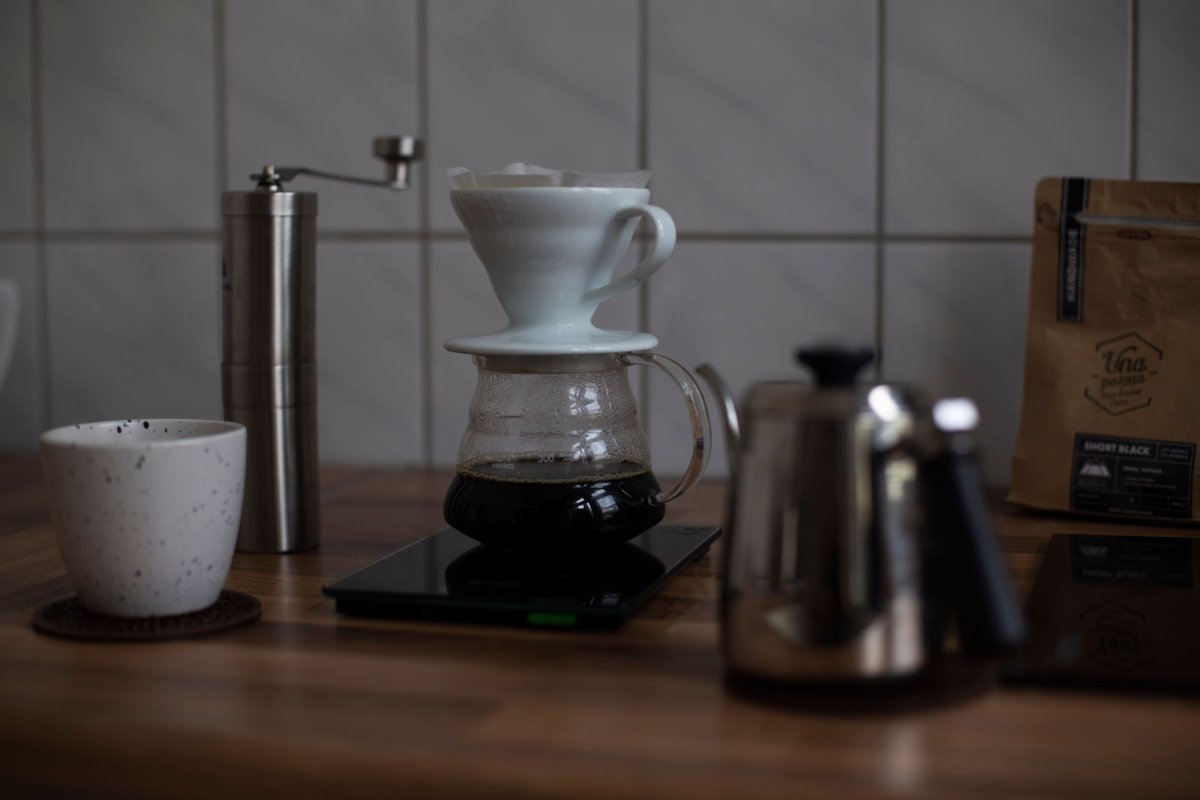
- Tare again so the display reads zero, then pour, watching the number rise to your target water weight.
Because the water total is visible while you pour, you can split it into stages (for example, a small first pour to wet the grounds, then the rest). See the V60 guide for a full recipe.
French Press
Put the empty press on the scale, tare, add the coffee (for example, 20 g), then pour the hot water to the target weight (for example, 300 g). After that the scale’s job is done; timing and pressing are covered in the French press guide.
Drip Coffee Maker
Weigh the coffee for each batch. For the water, the reservoir markings are only as good as the machine’s design, so check them once: put a jug of water on the scale and tare, then pour from it into the reservoir up to one of the markings. The amount you poured shows as a negative number on most scales (or weigh the jug before and after and subtract). From then on you know what “4 cups” on your machine really means in grams. More tips are in how to brew better drip coffee.
Espresso
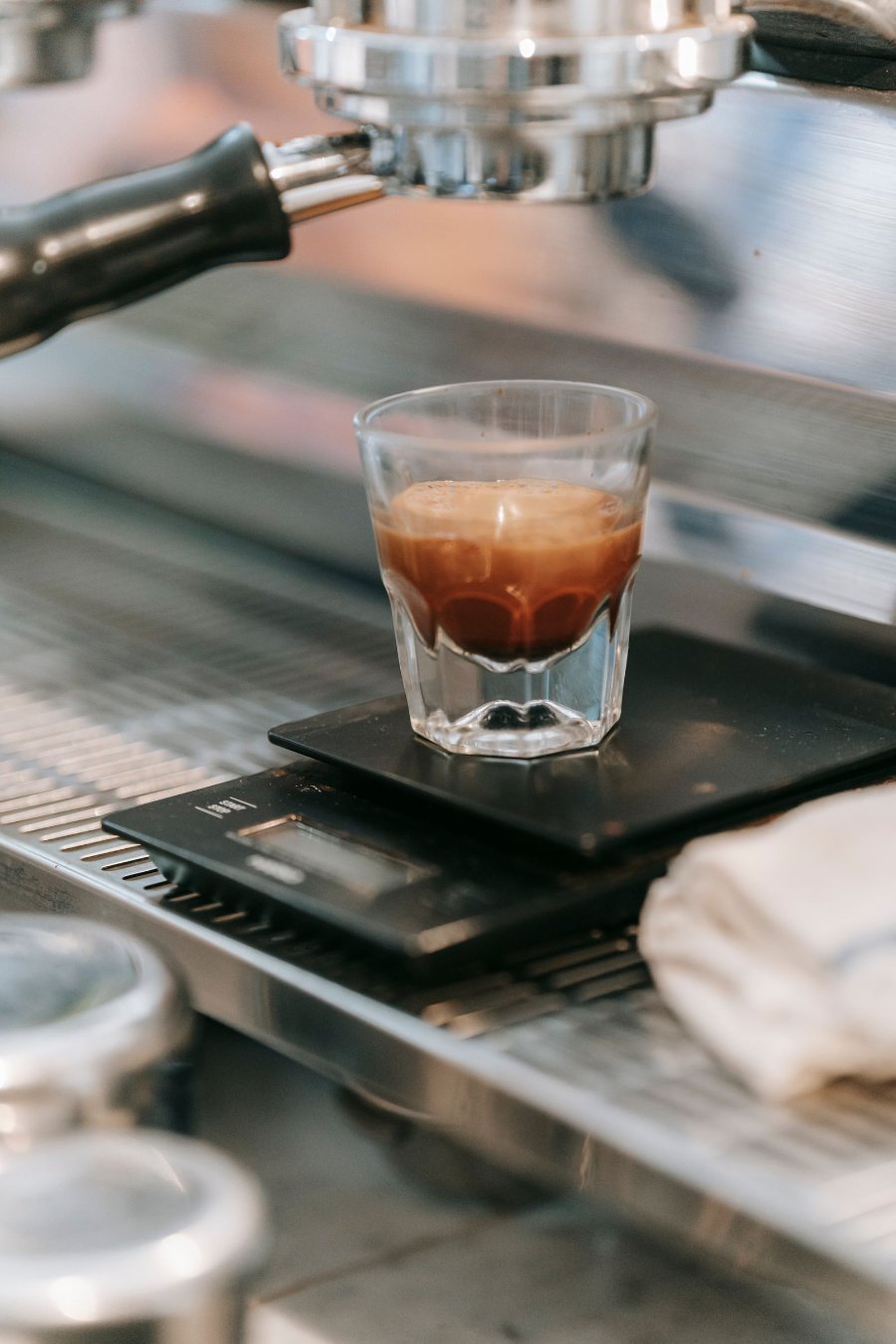
Espresso uses two weights: the dry dose in the basket and the liquid yield in the cup. A common starting point is 18 g in and about 36 g out (1:2). Weigh the dose, then put the cup on a small scale under the portafilter, tare, and stop the shot when the yield reaches your target. Weighing the yield is more reliable than reading the volume on a shot glass, because the foam on top makes the volume misleading. Here a scale that reads 0.1 g and fits under the spouts is useful. See espresso at home.
Measuring Without a Scale
Spoons and scoops measure volume, so the weight they hold changes with the grind, the roast, and how they are filled. They still work if you use them consistently.
- Tablespoons: Peet’s Coffee recommends 2 tablespoons of ground coffee (10 g) for every 6 fl oz (180 ml) of water, which works out to about 5 g per tablespoon and a ratio of 1:18. For a stronger cup, add a little more coffee.
- Your own scoop: if you can borrow a kitchen scale once, weigh three level scoops of your usual coffee and grind, and divide by three. That gives you the real weight of your scoop instead of a general estimate.
- Keep it consistent: fill the spoon or scoop the same way each time (level, not packed), and measure water with the same jug.
Small Mistakes That Throw Off a Measurement
- Forgetting to tare after adding coffee. If you pour water without zeroing, the target number has to include the coffee’s weight.
- Weighing only the coffee. The ratio depends on both numbers; guessing the water undoes the benefit of weighing the dose.
- Leaning on the brewer while pouring. Pressing on the dripper or resting the kettle on it adds weight to the reading.
- Worrying about half a gram. For filter coffee, 15.5 g instead of 15 g will not ruin the cup. The point is to know what you used so you can repeat it or change it deliberately.
A scale tells you what you did, not whether the result tastes right. If the coffee is sour or bitter, see bitter vs. sour coffee; if it is inconsistent from day to day, the grind may be the cause, which our grinder guide covers. Other habits worth checking are in common coffee brewing mistakes.
Sources
- United States Mint. Coin Specifications. Source for the coin weights (nickel 5.00 g, quarter 5.67 g, cent 2.50 g).
- The Engineering ToolBox. Water: Density, Specific Weight and Thermal Expansion Coefficients. Source for water density at room temperature and at 95°C (0.962 g/cm³).
- Peet’s Coffee. How much coffee should I use when brewing? Source for the 2 tablespoons (10 g) per 6 fl oz (180 ml) recommendation.
